Decision Frameworks
The Liquidity-Control Spectrum: A Decision Tool for Asset Owners Weighing Tokenization
Owners keep getting sold a binary — tokenize or don't. That framing hides the only questions that matter. Here is a five-axis way to locate your asset before you ever engage an advisor.
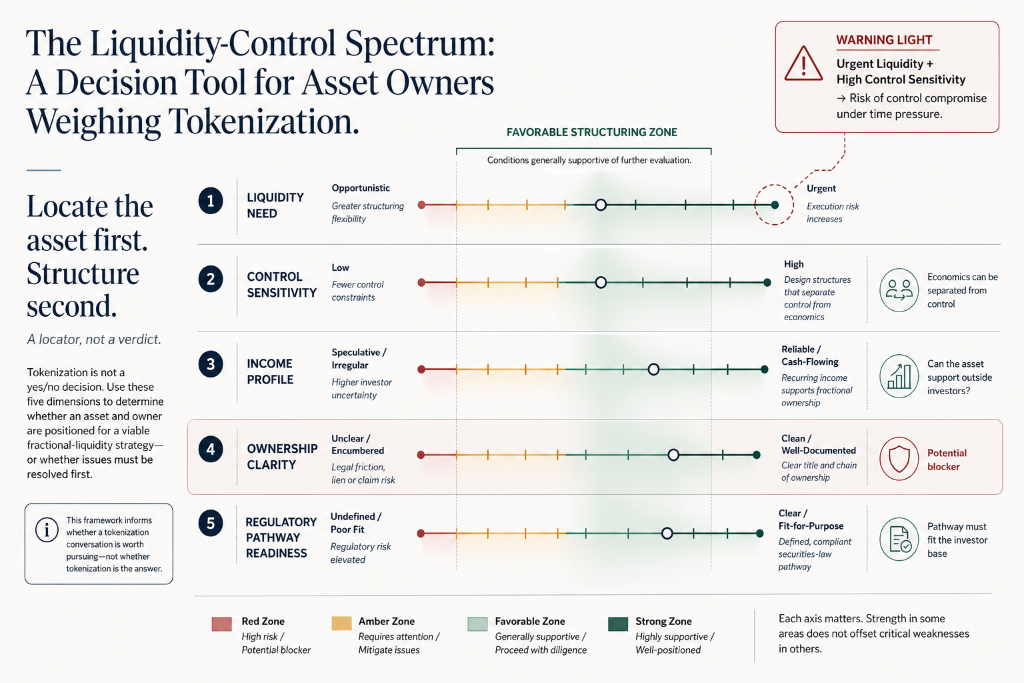
Owners keep getting sold a binary — tokenize or don't. That framing hides the only questions that matter. Here is a five-axis way to locate your asset before you ever engage an advisor.
The binary you're being sold
If you own a valuable, income-producing asset — a commercial building, an oil and gas working interest, a package of mineral royalties, a business that throws off steady cash — you have almost certainly been pitched tokenization. And you have almost certainly been pitched it as a yes-or-no decision. Tokenize your asset, or don't.
That framing is worse than unhelpful. It skips every question that actually determines whether the idea makes sense for you, and it collapses a nuanced structuring decision into a marketing prompt. The real decision is never "tokenize or not." It is a set of related questions about how much, on what terms, for which investors, and whether the timing and the asset support any of it at all.
We built a simple tool to replace the binary. We call it the Liquidity-Control Spectrum. It maps the decision onto five axes, and it lets an owner locate themselves before spending a dollar or taking a meeting. It will not tell you to do a deal. It will tell you whether the conversation is worth having — which, for a lot of owners, is the more valuable answer.
Axis 1 — Liquidity need: opportunistic or urgent
Start with the honest reason you are considering this at all. There is a wide gap between "I'd deploy capital into a specific opportunity if I could free it up" and "I need cash by a date." Both are legitimate. They lead to very different decisions.
Opportunistic liquidity gives you time, and time is leverage. You can structure carefully, choose your investors, and walk away if the terms aren't right. Urgent liquidity does the opposite: it compresses your options and tempts you toward whatever closes fastest, which is rarely whatever serves you best. The owners who get hurt in this market are almost always the ones who came to it in a hurry.
Axis 2 — Control sensitivity
How much operational authority must stay in your hands, non-negotiably? For some owners the answer is "all of it" — they built the asset, they run it, and any structure that dilutes their decision rights is a non-starter. For others, particularly passive holders of income interests, control is far less precious than liquidity.
This matters because partial tokenization is specifically designed to separate economic participation from operational control. You can sell a minority economic interest — a claim on income and upside — while retaining the majority stake and the decision rights that come with it. If control sensitivity is high, that separation is the entire appeal. If it's low, you may have more options than tokenization alone.
There is a quiet correlation worth naming. Control sensitivity and liquidity urgency tend to move in opposite directions among owners who regret their deals. The ones in the biggest hurry give up the most control, because urgency makes them accept structures they'd otherwise refuse. If you find yourself high on both axes, treat that as a warning light, not a green light.
Axis 3 — Income profile
Can the asset actually support fractional investors? Tokenized real-world assets are, at bottom, income instruments. Investors buy a fractional interest because they want a share of the cash flow and the upside. If the asset produces reliable income, it is genuinely investable. If it does not — if it's a speculative or pre-revenue holding — fractionalizing it is far harder and, often, the wrong tool.
This is why mineral and royalty interests, cash-flowing commercial real estate, and steady operating businesses sit naturally toward the favorable end of this axis. They come with a schedule of income that a fractional structure can distribute. It is also why the fraction you can realistically tokenize is not a matter of preference. It is a function of how much income the asset generates and how much of that income can support outside investors. The asset sets the ceiling, not the owner's wish.
Axis 4 — Ownership clarity
Here is the axis owners most want to skip and most regret skipping. How clean is your ownership? Clear title, no unresolved liens, no partner with buried consent rights, no prior encumbrance that predates your ownership of a mineral interest?
Ownership clarity is the most common silent killer of a tokenization deal — more common than valuation disputes or market conditions. The reason is structural: you are inviting outside investors into a fractional interest, and their counsel will examine the ownership with a rigor your own enthusiasm didn't. Anything unresolved surfaces then, at the worst possible time, and can delay a raise by months or end it.
The good news is that this is the cheapest axis to check. An afternoon with your own records and, where needed, a quick review with counsel answers most of it. That is precisely why, in a proper feasibility review, ownership clarity comes second — right after confirming the asset produces income, and long before anyone designs a token.
Axis 5 — Regulatory pathway readiness
Finally: is there a compliant regulatory pathway that fits your investors and your goals? A tokenized interest in a real-world asset is, in nearly all cases, a security. That means it lives inside securities law, and the offering must rely on an exemption — Reg D, Reg A+, Reg S, or another route — chosen to match your investor base, your marketing plans, and how much you intend to raise.
Owners routinely treat this as a detail to sort out later. It is not a detail; it is a determinant. The exemption shapes who can invest, how you can talk about the offering, and what you will owe investors afterward. An asset can score well on the first four axes and still be a poor candidate today because the available regulatory pathway doesn't fit the investor base the owner has in mind. This axis is also where the maturing U.S. framework matters — but note that compliant, exemption-based structures already work under existing rules, so readiness here is about fit, not about waiting for new law.
Reading your position: three archetypes
Consider three owners plotted on the spectrum. The commercial real estate sponsor with an opportunistic liquidity need, high control sensitivity, strong income, clean title, and an accredited-investor base sits near the center of the favorable zone — a strong candidate for a carefully structured minority raise. The mineral-royalty owner with passive income, low control sensitivity, naturally divisible interests, but a tangle of legacy title issues scores beautifully on three axes and is blocked on one — fixable, but only if addressed first. The business owner in urgent need of cash, high control sensitivity, thin documentation, and no defined investor base scores poorly across the board; for them, the honest answer is that tokenization is probably the wrong tool right now.
Notice what the spectrum does. It turns "should I tokenize" into "where does my asset sit, and what would move it." The second question is answerable. It also makes the blockers visible and, often, cheap to address.
What the spectrum can't tell you
The spectrum is a locator, not a verdict. It cannot price your specific asset, design your token economics, or select your exemption — those require real diligence and qualified counsel. That is the purpose of a feasibility engagement: to take your rough position on these five axes and pressure-test it against your actual documents, income, and goals, ending in a clear go or no-go.
And a no-go is a legitimate, valuable outcome. If your asset genuinely doesn't belong on this spectrum, the most useful thing an advisor can do is tell you so — before you've spent months and money learning it the hard way. An advisor whose incentives only reward a "go" cannot give you that answer honestly. One who sits on your side of the table can.
Locate yourself first
For context, the tokenized real-world asset market crossed roughly $30 billion in on-chain value by mid-2026, up several-fold in a year (rwa.xyz; Stobox mid-year report, July 2026). That growth is real, and it built genuine infrastructure and investor appetite that private owners can now use. But market size is not a reason to act, and it is emphatically not the same as liquidity — a large share of tokenized value still doesn't move at all (Stobox; Forbes, July 2026).
The reason to act, if there is one, is that your asset sits in a favorable position on these five axes and you have something specific you'd do with the liquidity. Start there. Plot yourself honestly on liquidity need, control sensitivity, income profile, ownership clarity, and regulatory readiness. If you land in the favorable zone, the next step is a conversation. If you don't, you've saved yourself the most expensive kind of mistake — the one you make enthusiastically.
If you want to know exactly where your asset sits, a Discovery and Feasibility engagement plots it in two to four weeks and ends in an honest go or no-go. Either answer is worth having.
Disclaimer
This article is for general informational purposes and is not legal, tax, investment, or financial advice. Defiant Consulting is an advisory firm and coordinates with licensed securities counsel, broker-dealers, and other qualified professionals; it does not itself provide legal services or act as a broker-dealer. Regulatory references are current as of July 2026 and subject to change. Illustrative figures and archetypes are examples, not representations of any specific engagement or result.
Take the Next Step
Explore what your asset could unlock.
If this article resonated with your situation, schedule a confidential consultation. We'll assess your asset and discuss whether tokenization is the right path for you.